
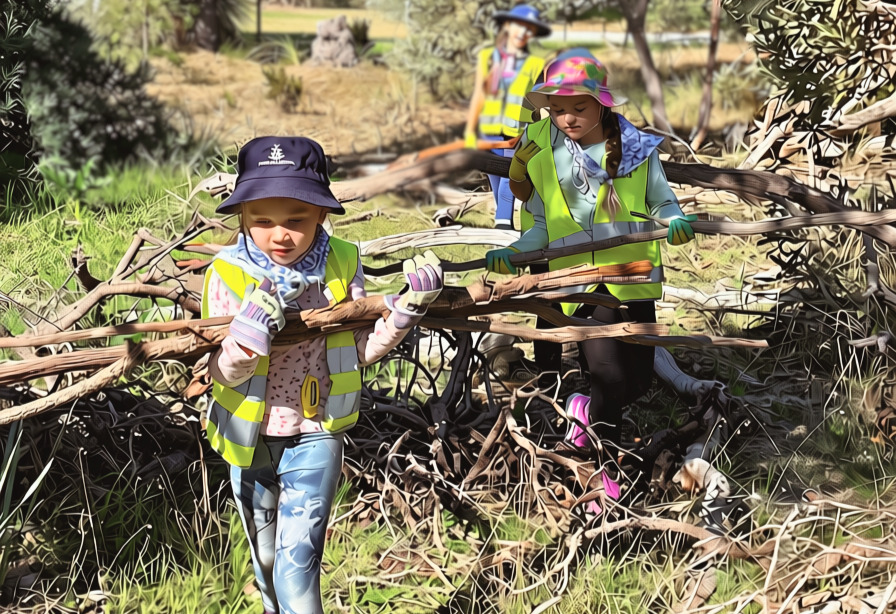
Bush School mornings at Moerlina begin with getting ready.
Before we leave school, bags are checked. Do we have enough water? Food? Everything we need for the morning? Bush School vests and neckies go on. We do a name call, go to the loo, fill our water bottles and board the bus for the 30-minute journey south.
Our destination is a section of public bushland in Beeliar Regional Park, near Bibra Lake.
There is no playground waiting for us. No toilets, buildings or specially constructed activity areas. It is simply natural bushland.
And that’s very much the point.
Arriving at Bush School
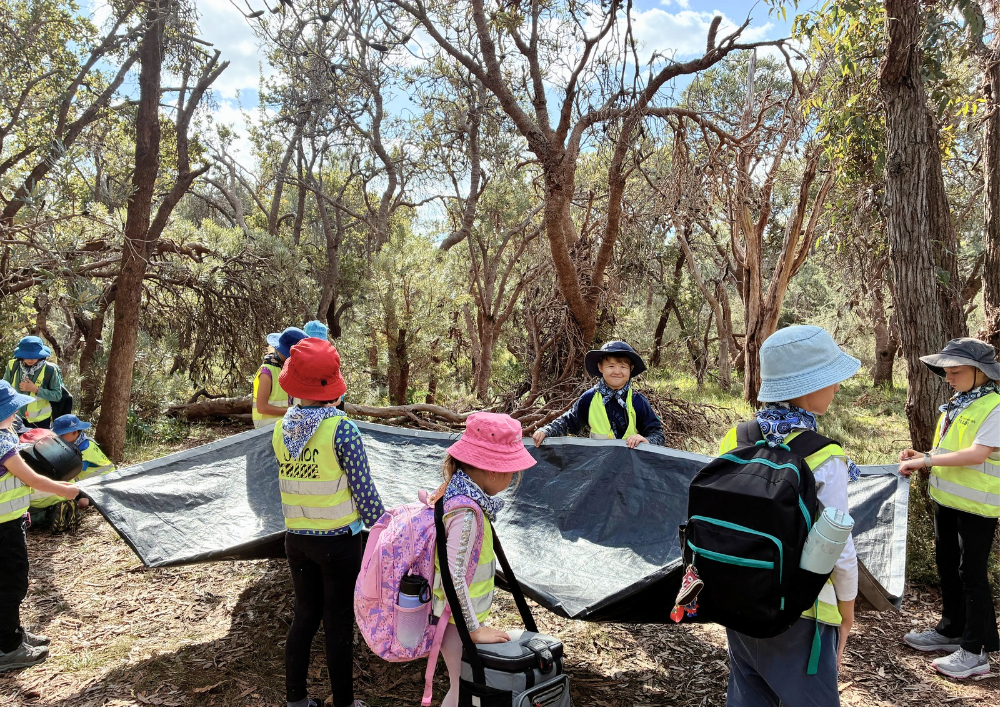
When we arrive, one of the first jobs is setting up our large tarps, which give us a base for the day. Then we come together in a circle.
A child leads our Acknowledgement of Country, and together we say our Bush School Pledge. It begins simply: “I pledge to do my best at Bush School.”
We pledge to take care of ourselves and others, to take responsible risks, to respect our teachers and elders, and to tread carefully on Mother Earth. And, because this is Moerlina, our promise not to hurt any living things comes with one small qualification: “Except annoying bugs.”
Next comes what we call the ‘blow off’. Everyone tests their whistle with a good blast. Whistles are part of our safety system, giving every child a way to alert others if they need help.
We also walk the Bush School boundaries. Children learn where they can go, familiarise themselves with their surroundings and notice what may have changed since their last visit.
These routines matter. Bush School offers children considerable freedom, but that freedom sits within clear expectations and shared responsibility.
And then the day opens up.
So, what do children actually do?
There isn’t one answer.
Children might build or improve a base, work on bush crafts or art, practise knots and lashings, investigate plants and animals, play games or simply explore.
Sometimes they work in their clans. There are trust and team-building activities, challenges to solve together and opportunities to develop practical bush skills. At other times, children initiate their own play and projects.
An idea might begin with two children and gradually attract six more. A base built on an earlier visit might need repairs or a complete rethink. Something spotted on the ground might lead to a question, an investigation or a long conversation.
And sometimes children just play. We really value that too.
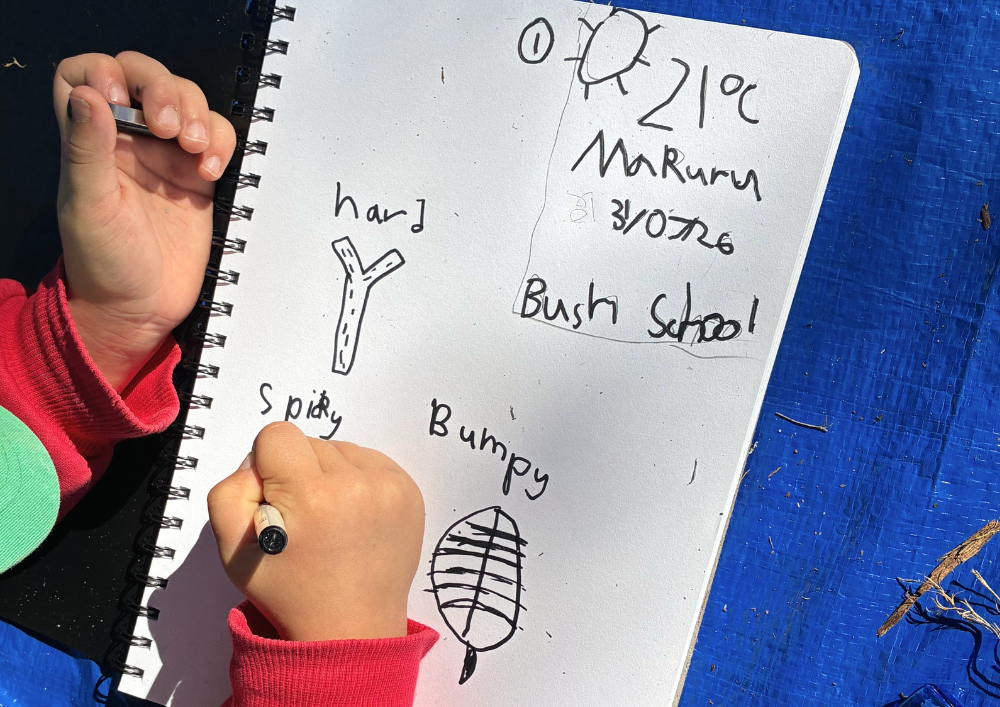
Learning that doesn't always look like a lesson
There is a great deal of learning happening at Bush School, but it doesn’t necessarily arrive neatly divided into subjects.
Building a base involves planning, problem-solving, cooperation and persistence. Knot tying requires concentration and practice. Moving through uneven natural environments builds physical confidence and judgement. Group activities require children to communicate, negotiate, listen and work with people whose ideas may be different from their own.
The bush also presents questions we couldn’t necessarily have planned back at school.
What plant is this? What made that? Why has this changed? Will this branch hold? How can we build here without damaging what’s growing underneath?
Over time, children build knowledge of the plants and animals around them and deepen their connection with the natural environment. There are opportunities to connect with Indigenous understandings of land, place and caring for Country.
Teachers are there alongside the children — leading, observing, questioning, helping and sometimes deliberately standing back. We don’t need to direct every moment.
There is also time. Children return to the same place again and again. They notice seasonal changes because they know what was there before. Bases evolve over several visits. Skills are practised again. Ideas can be revisited rather than abandoned because a lesson has ended.
There is time to wonder, experiment, make mistakes, change plans and try again.
”I think Moerlina is pretty good at teaching wisdom, like in bush school we learn to take risks in a safe way, so that you can take risks but know how to do it.”
– Moerlina Student
Learning beyond the classroom
Bush School reflects something important about learning at Moerlina. We want children to know things, of course. We also want them to know what to do with what they know — to think, question, create, collaborate, solve problems and adapt when things don’t go according to plan.
As children grow, learning beyond the classroom continues in other ways. Our senior students also experience Beach School, where the coastline becomes another place to explore, observe, question and learn.
This doesn’t mean we believe children should always learn outside. Children need classrooms too. They need books and explicit teaching, numbers and writing, quiet concentration, discussion and time working closely with their teachers.
But they also need movement, space, challenge, nature and play. They need opportunities to make decisions, take responsible risks and use their learning in places where the answers aren’t already known.
Bush School has been part of Moerlina life since 2011. It isn’t an occasional excursion or something added around the edges of the curriculum. It reflects something we have long believed about childhood and learning: the world beyond the classroom has so much to teach us too.
Eventually, we pack up the tarps, gather our belongings and check that we have everyone and everything — and that we’ve left the bush as we found it.
Then it’s back on the bus, usually a little dirtier than when we arrived, and carrying new skills, new questions and another day’s experience of learning and growing up well together.
Other stories from Moerlina School
Making the Transition Gentle
Changing schools can feel enormous when you are the parent making the decision. Understanding that difference can help make a school transition much gentler.
When to Change Schools
Changing schools is a significant decision. Before making it, it helps to slow the process down and ask some practical questions.
Known, Not Managed
All children have difficult days and periods when school feels hard. The question is whether you are seeing an occasional difficulty or an ongoing pattern.